After I posted the RunBTS Ep. 33 cross stitch pattern, I had many asking for help to learn to cross stitch. Cross stitch is a great craft because it is relatively cheap and easy to learn. You just have to have patience to stab something hundreds if not thousands of times. This series of posts will give you the tools to get started in this craft. Feel free to ask questions along the way, and I will try my best to answer them.
My goal is to post here every Friday until we are ready to stitch on our own. Then every Tuesday I will post a reel to Instagram. Starting two weeks in, I will begin a series of YouTube videos that walk you through what we have learned here. That means in two weeks the first YT video will be posted, barring any unforeseen real-life things getting in the way.
This week we are going to learn about cross stitch and gathering materials to stitch.
What is Cross Stitch?
Cross stitch is a particular type of embroidery. Instead of being composed of lots of different stitches, cross stitch uses “X’s” to create a grid type of pattern. You can think of cross stitch as impressionistic in creating large images. Up close the image may seem distorted, but far away magically becomes a work of art. The form dates back to the middle ages. It has persisted in popularity because of its ease. While recreating charts is relatively easy, do not mistake this as simply a crafty craft. When I say craft, I mean it in the old sense. Crafts take skill, and skills have to be developed over time. Creating a cross stitch pattern takes real art skills. While there are many programs that let you convert images to charts, it still takes artistic skill to make a pattern that achieves its intended purpose. Cross stitching in actuality takes skill and is not simply the same as first-grade construction paper creations. As you can see from my digression, I have real thoughts about the devaluation of female skilled labor that I will get into in another post. For now, know that this is an old art form that you can learn.
What do I need to start?
Cross stitch takes very little to get started. You need fabric (aida), a needle (tapestry), scissors, a hoop, floss, and a chart. Let’s break down each of these items.
Fabric
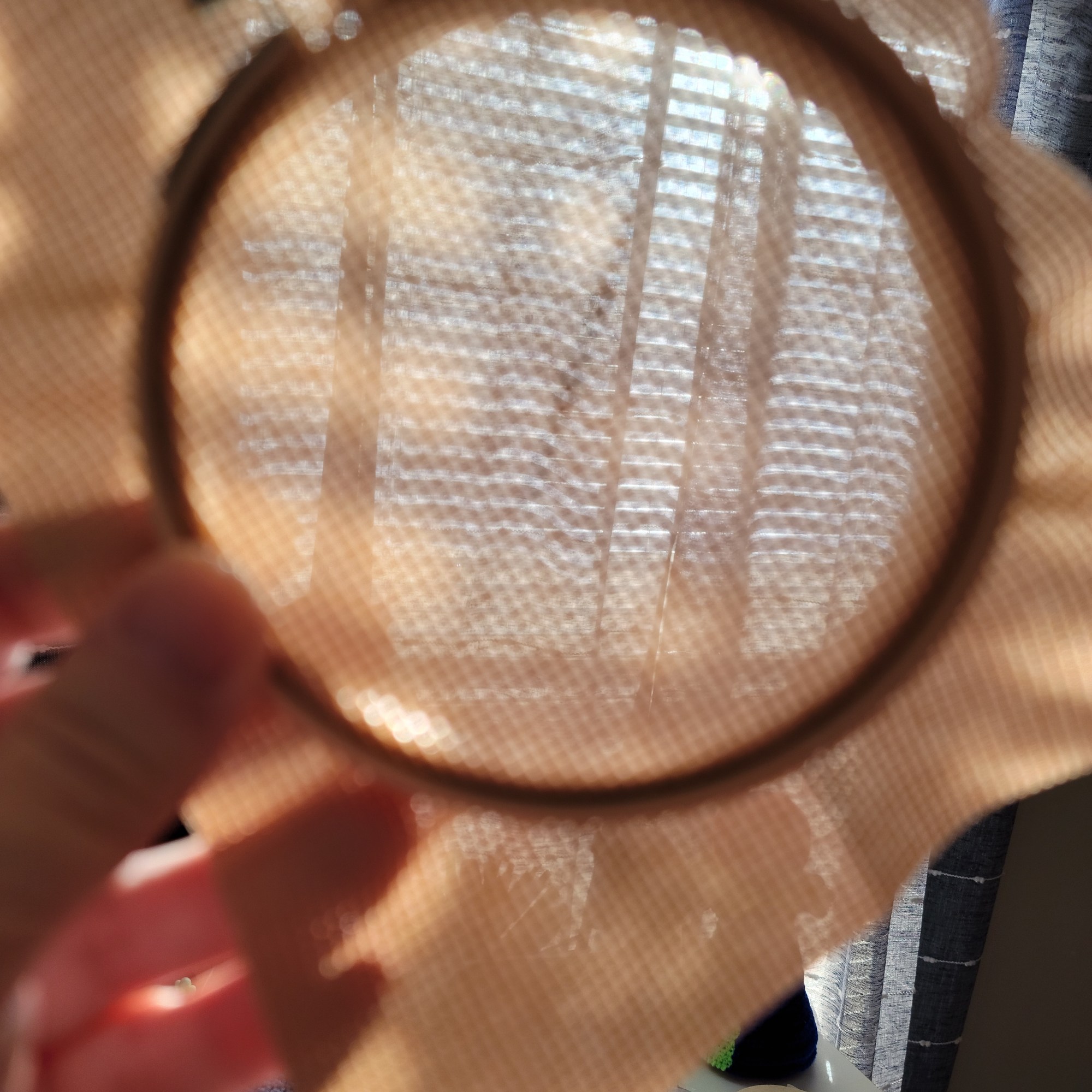
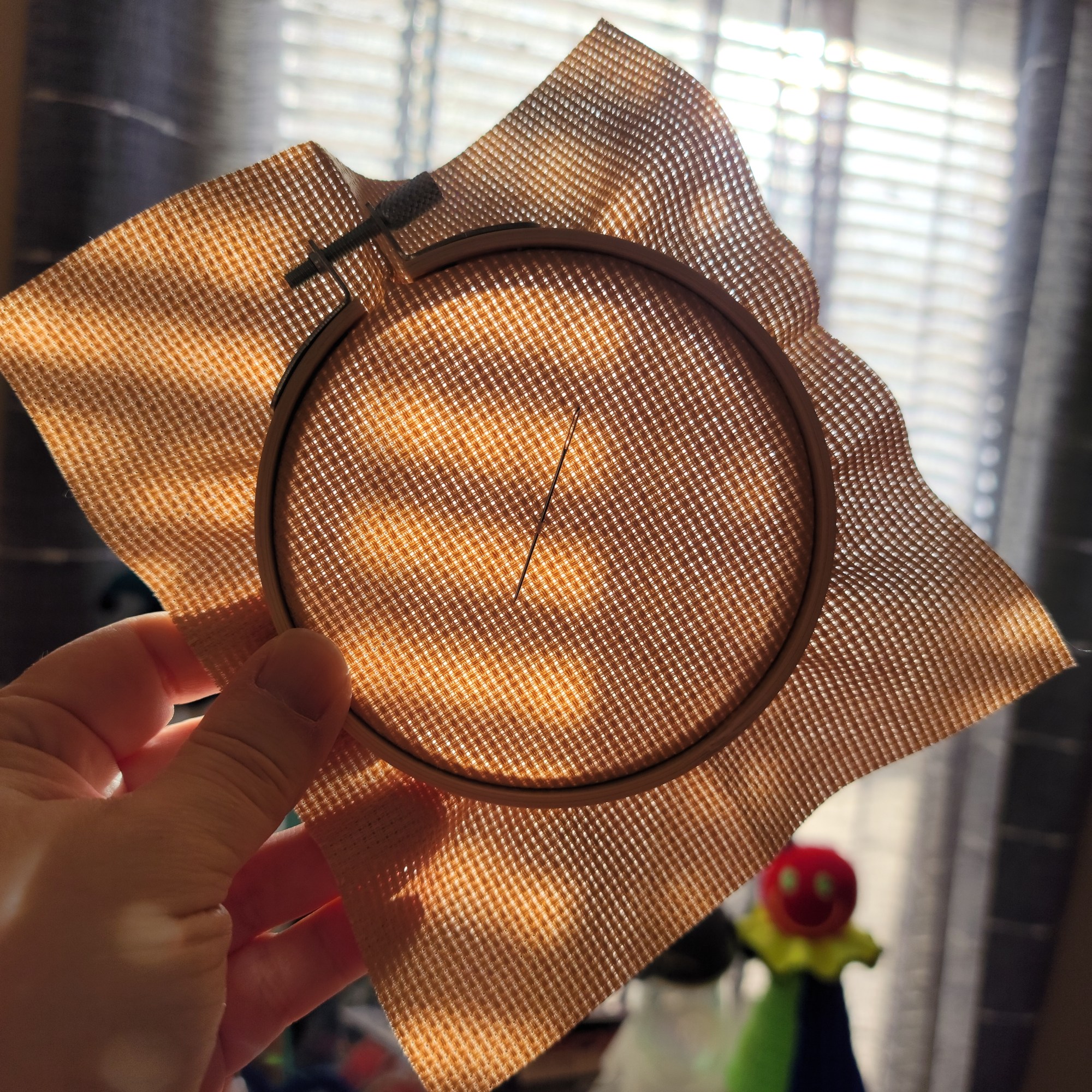
Most often, cross stitch will be done on Aida fabric. Aida is an evenweave fabric. Evenweave fabrics use the same number of threads across and up to form a uniform fabric. This weave creates a grid pattern in the fabric. That means there are little squares of the same size across the fabric, which makes for easy stitching. Aida comes into different thread counts, which equates to a different amount of square or cross stitches per inch. I most often use 14-count Aida (this is the common count for most stitchers). However, patterns are easy to convert between different counts because the pattern stays the same, but when stitched it automatically becomes larger or smaller based on the count of the weave.
The weave in Aida also makes it have a see-through quality. This means you have to be careful when you travel with certain threads across open spaces of fabric. I will go into more detail about this in a later lesson. Aida comes in many colors. Changing the color of fabric can dramatically change the way a project looks. Its a way to add your own spin to a pattern.
Here’s some pictures of what Aida looks like.

You can find aida easily at your craft store or on Amazon.
Needles
Cross stitch uses blunt end needles. These are sometimes called tapestry needles. They also come in various price ranges. If you are a beginner, do NOT buy the most expensive needles. Make sure this is a craft that you want to continue before you purchase something expensive. That is a good rule for any craft.
DMC has some really good needles for beginners. They are pretty cheap. I cross stitch a good bit, so I bought Tulip brand Hiroshima tapestry needles. These would be a good choice if you decide that cross stitch is your thing and you will be doing it a lot and for a long time. The difference between expensive and cheap needles are their sturdiness and glide. The DMC needles really are good for beginners.
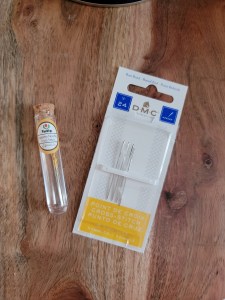
Needles come in different sizes. The larger the number of the needle the smaller the needle. A size 24 needle is good for 14-count aida. The reason the size of the needle matters is the size of the holes in the fabric are different sizes. You want your needle to pass through the holes without distorting the fabric.
Scissors
This is easy. Any pair that can cut. I keep a small pair with my cross stitch floss, but it really doesn’t matter which pair you use. You just need any scissors that can cut floss.
Hoops
The aida has to be stretched on a hoop to work the cross stitch. Hoops are also called frames. They come in all types from cheap wood circular hoops to plastic q snaps to scroll frames. I recommend for beginners to start with the classic and cheap circular wooden hoop. They are usually under $3 bucks at any craft store. Price depends on the size of the hoop.


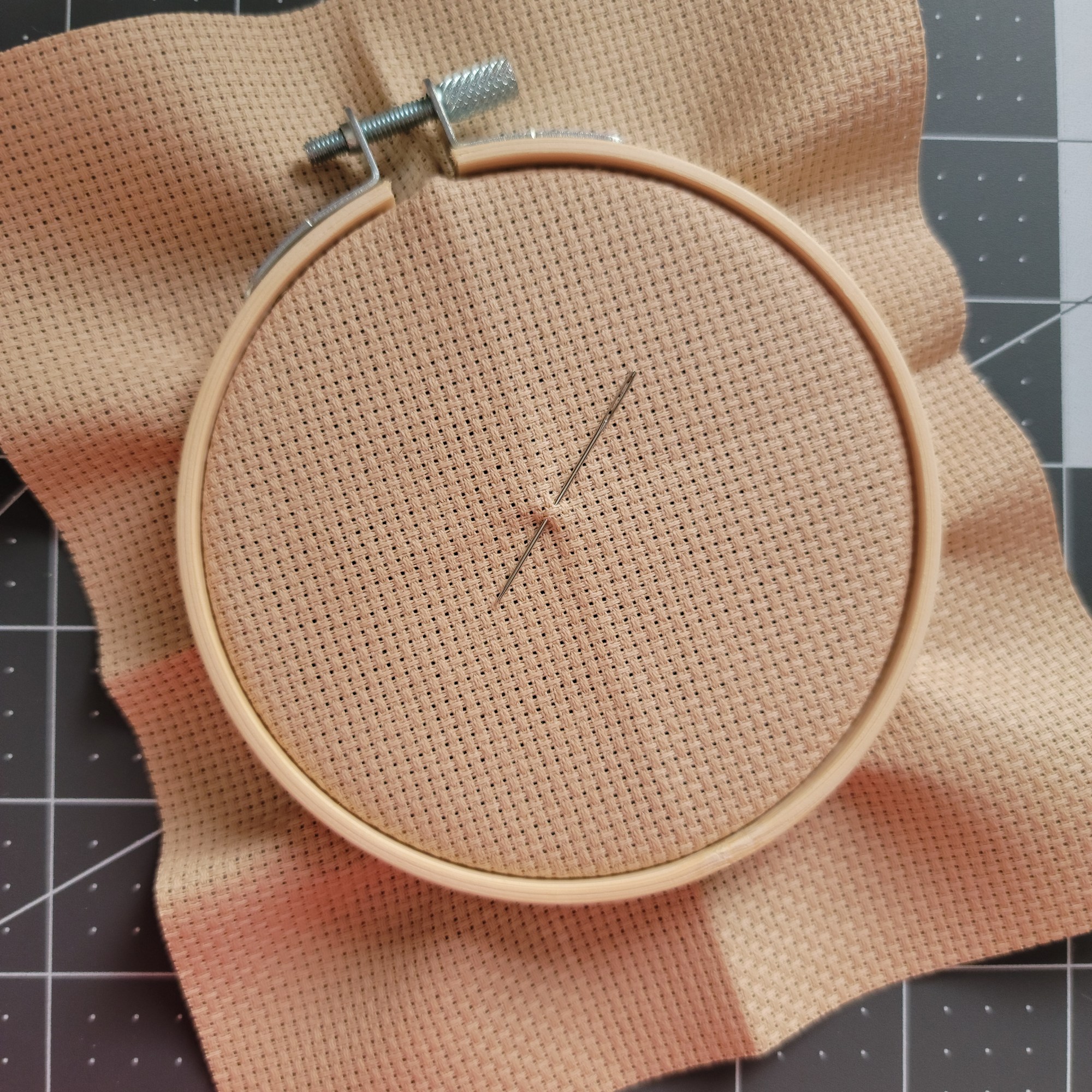
These wood hoops have one problem they leave a ring on the fabric. I remedy this by spraying my fabric with Flatter spray and ironing. Make sure when you iron your project you turn off steam and put a towel under your stitches to keep from crushing them with the iron. Make sure you only iron your cross stitch from the back side.
People use the q snap or plastic frames to try to avoid these marks. The problem with the q snap frames is that the material slides on the slick plastic. That can be as frustrating as the lines left by the cheap wood hoops, especially when you pay so much more for the plastic frame.
Scroll frames are usually used for large projects and usually have some kind of accompanying stand. These are for experienced cross stitchers. Just know they exist.
Floss
Floss is the thread that you use for cross stitching. The most commonly used brand is DMC. DMC is a good floss that is relatively cheap…about 50 cents a skein. Floss comes in skeins. A floss strand has 6 individual threads in the strand. Cross stitch uses different amounts of threads depending on the fabric count and stitch being used. For 14-count aida, most patterns call for 2 threads. Backstitching will usually use 1 strand (we will talk about backstitiching in another post). This means that you will cut a strand of floss from the skein or bobbin and then separate the threads. You will pull two at a time off the strand that has been cut. Do NOT pull them individually. Pull two strands at a time, together. I will make a reel of this process and post it soon.
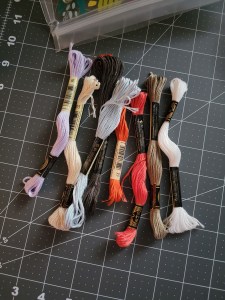
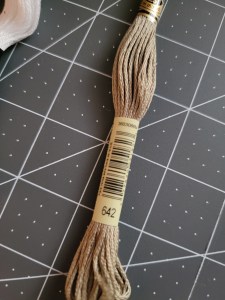
Floss has a label on the bands that indicate the color number. When you walk into the craft store, the floss is sorted by number. You will know the floss number that you need because your cross stitch chart will tell you.
To store your floss, you wrap the floss around bobbins. Bobbins are usually plastic or paper. I prefer the paper bobbins because you can write on them. This is what bobbins wrapped in floss look like:
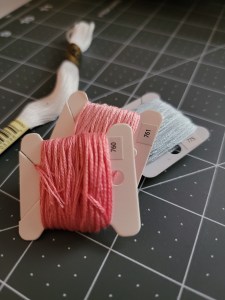
Bobbins make it easier to store and use your floss. When I separate threads from my cut strands, I wrap the unused piece of the strand back around the bobbin.
You can also purchase plastic boxes to store these bobbins. I organize my floss by number, but you can organize by color. I think as a cross stitcher it is better to organize by number because it makes finding the number I need to use easier. Embroiderers tend to sort by color.

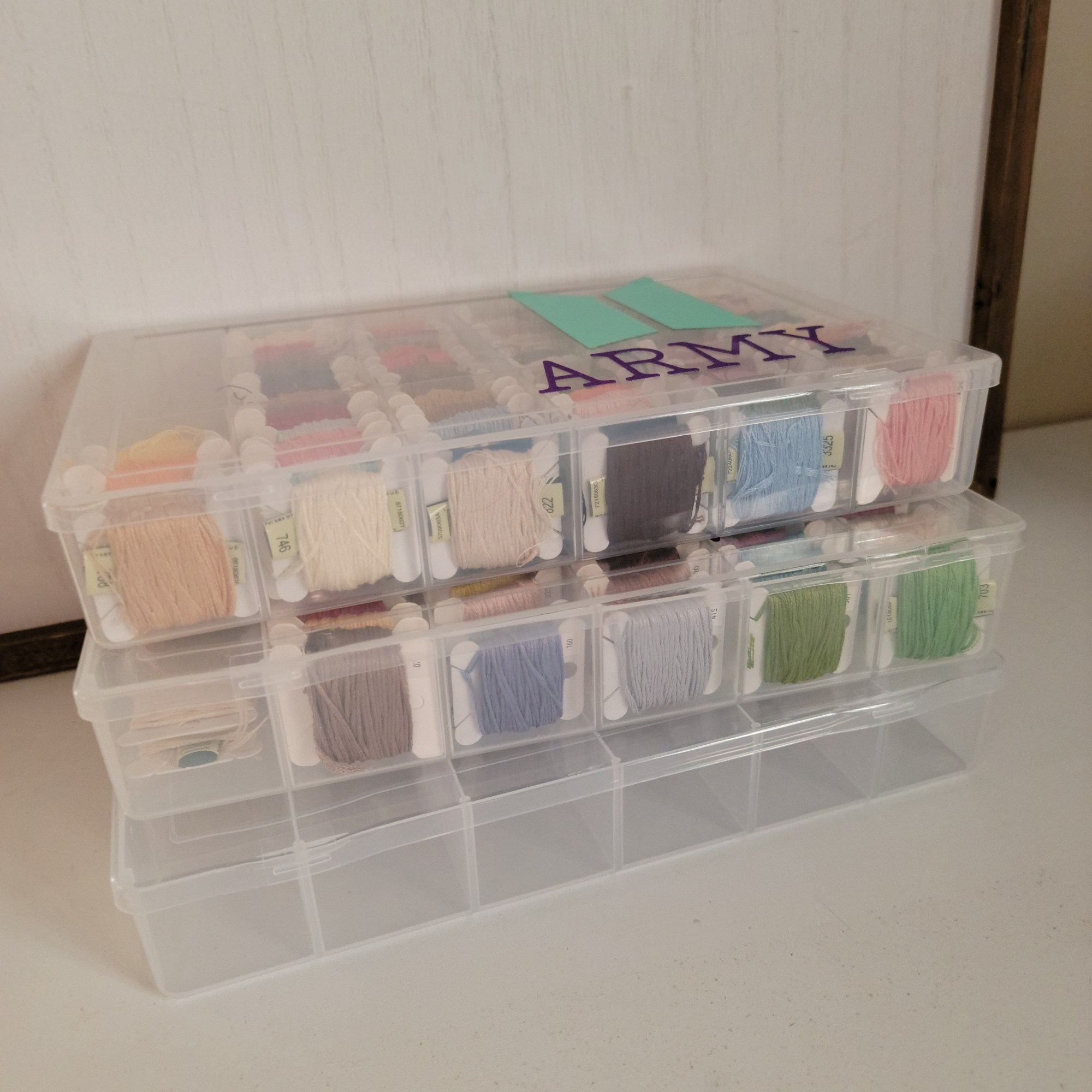
These boxes cost me about $2.50 each at the craft store. I had to find the paper bobbins on Amazon. The craft store I use only sells plastic ones.
Patterns or Charts
You will also need a pattern to follow whether you created that pattern yourself or not. I will go into more detail about patterns (also called charts) in the next post. We will talk about piecing a pattern and reading a pattern. For now, just know you need one, and they are grids.

Last, you will need some type of working pouch or tin. I pull the colors I’m currently using and put them in a cookie tin.

I put my needles in the tin. Under the lid I put magnets so that my scissors will stick to the top. This makes it easy to access and carry around all the supplies I need for the project I’m working on.
…and that’s it. These are the materials you HAVE to have. Next time, I will talk about patterns and charts, and I will also talk about some nice to have things.
Go out there and gather your supplies. In a couple of weeks, we will work a pattern I’m going to give you. It will be small but it will help you start.
Happy Crafting!
 Mell Makes Crafts